

Reduced paper checking time from 10 hours to 2 hours
Learn how CIT-U teachers cut grading time by 78.46% across all assessment types while 94% reported a lighter workload and faster turnaround.
Download Full ArticleExecutive Summary
Manual grading of handwritten exams has long been a challenge at Cebu Institute of Technology-University, with teachers reporting up to 7.41 hours of grading per week, often leading to feedback delays and increased workload pressure. In response, the institution explored the use of GradeChum—an AI-powered grading assistant that supports automated checking for handwritten exams, including identification, enumeration, essays, mathematical problem-solving, multiple choice, written coding/programming, and visual/diagram-based question items.
This case study evaluates the institution's adoption of GradeChum. The purpose of this case study is to assess the time savings, efficiency improvements, and teacher experience outcomes associated with GradeChum usage.
Based on structured survey responses from 17 teachers and students across multiple departments who are using GradeChum during the first semester of school year 2025-2026, key findings show that:
- 78.46% average reduction in grading time across all item types.
- 83.59% decrease in turnaround time.
- 60% reduction in post-checking score overrides.
- 94% of teachers reported reduced workload and faster turnaround.
- 89% of students found the platform accurate, fair, and transparent.
Institution Background
Cebu Institute of Technology-University (CIT-U) is a private higher education institution located in Cebu City, Philippines. Known for its strong programs in engineering, computer, and allied sciences, CIT-U has a longstanding commitment to academic innovation and technological integration.
The university has an over 15,000 students across undergraduate and graduate programs. CIT-U offers basic education, undergraduate and graduate programs including:
- Engineering and Architecture
- Management, Business and Accountancy
- Arts, Sciences, and Education
- Nursing and Allied Health Sciences
- Computer Studies
- Criminal Justice
Faculty employ multiple choice, identification, enumeration, problem solving, essay-type, coding/programming, and visual/diagram-based assessments. Four major exams are done every semester: Prelim, Midterm, Pre-Finals, and Finals. Quizzes and seatworks are mostly done weekly or bi-weekly, depending on the course. Furthermore, teachers handle 5 sections on average, each with 40 to 50 students.
Challenges Due to Manual Checking
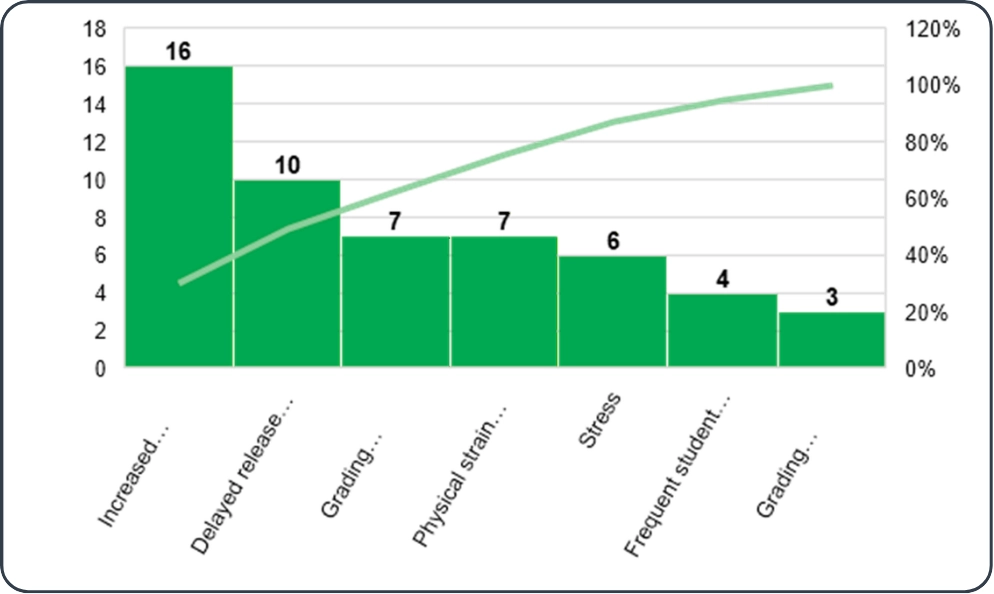
Manual exam checking creates significant strain on institutional workflows. The most reported issues were increased workload (94%), followed by delayed grade release (59%) and grading inconsistencies or errors (41%). Teachers also cited stress (35%), physical fatigue (18%), and frequent student recheck requests (24%) as key concerns. In addition, 82% cited they need to revise scores/grades after manually checking the assessments.
These challenges highlight how manual grading impacts not only teacher well-being but also feedback timeliness and grading accuracy—underscoring the need for more efficient, reliable solutions like GradeChum.
Key Results & Findings
This case study draws from a survey of faculty members at CIT-U who used GradeChum across various exam periods and question types. The findings reveal meaningful gains in efficiency, satisfaction, and instructional support.
Grading Time Saved
To assess the impact of GradeChum on grading efficiency, teachers were asked to estimate the time they typically spent checking exams in a standardized instructional setting: a single class of 40 students answering various item types. These included 10 identification items, 5 enumeration items, 5 essay questions, 5 mathematical problem-solving items, 15 multiple choice (shaded) items, 5 written coding/programming tasks, and 5 visual or diagram-based questions per student.
GradeChum reduced the total grading workload by 78.46%, with significant reductions across all item types shown in the table below:
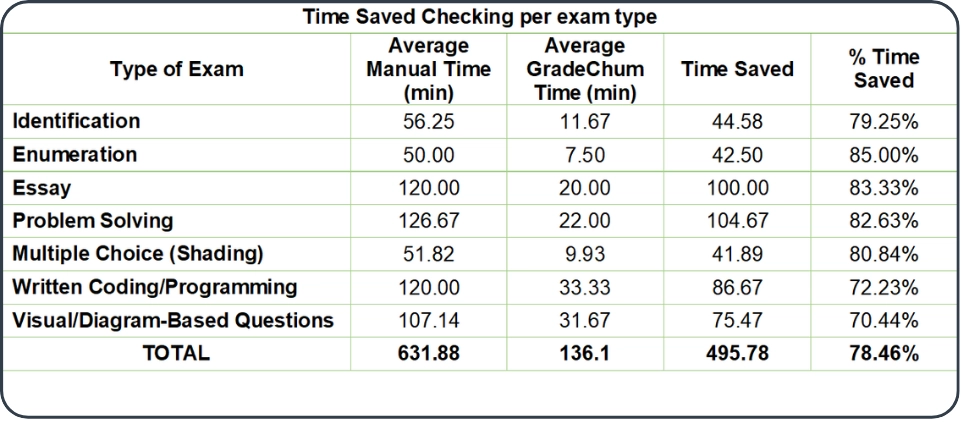
On average, teachers spent a total of 631.88 minutes manually grading each exam set across these item types. With GradeChum, this dropped to just 136.1 minutes, resulting in an average time savings of 495.78 minutes per set, or a 78.46% reduction.
The largest savings occurred in essay and problem-solving types, where checking times were cut by over 100 minutes per set. Even traditionally fast-to-check formats like multiple choice and identification saw substantial reductions of over 40 minutes per set.
Before using GradeChum, teachers spent 100–400 minutes manually checking one exam set per class, often stretched over several days, limiting time for lesson preparation and student feedback. After adopting GradeChum, that burden was reduced to 30 to 100 minutes per exam, streamlining exam cycles and accelerating turnaround times. In fact, 100% of the teachers reported that GradeChum saved time checking assessments.
Scaled across an average academic load of five sections with 45 students each, and applying a standard item distribution based on local and international literature, total grading time without automation amounted to approximately 118.5 hours per semester. With GradeChum, this was reduced to just 25.5 hours, freeing up over 465 hours per teacher each semester.
Rather than leaving this time unused, teachers redirected it into high-impact activities. Based on teacher responses and literature (Gallup-Walton, 2025; EEF, 2024; McKinsey & Co., 2020), they can use time saved each semester to complete any of the following professional tasks:
- Prepare 3 additional fully developed lessons
- Participate 12 extracurricular activities
- Conduct 12 more student consultations or collaborative meetings
- Complete 4 research tasks or outputs
- Produce 12 accreditation-related documents
- Attend up to 8 training or upskilling sessions
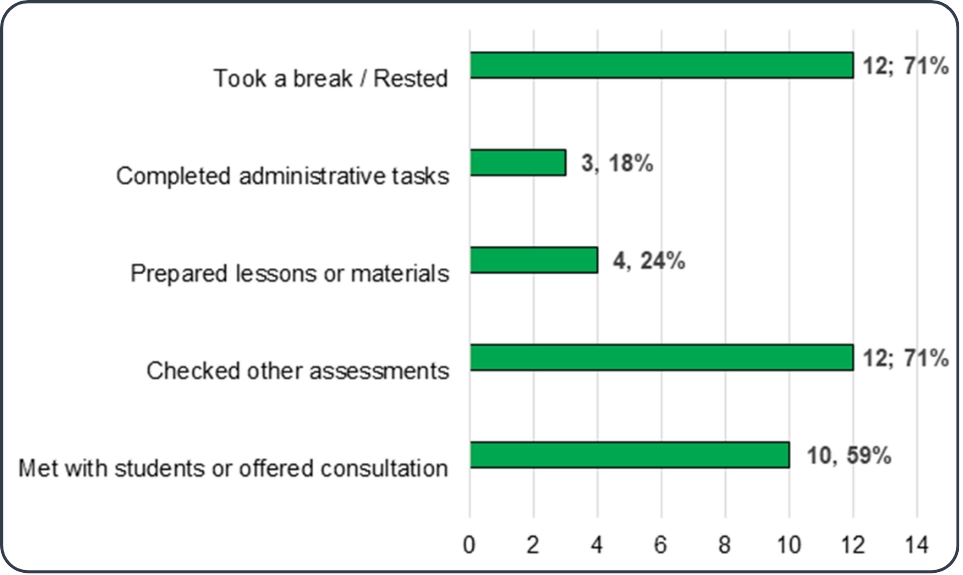
Survey data confirms these patterns: 71% of teachers used the time saved to rest or recover from peak workloads, while another 71% used it to check other assessments. 59% conducted student consultations, 24% prepared additional lessons or materials, and 18% completed administrative tasks. These findings illustrate not just efficiency gains, but meaningful improvements in teacher well-being and academic responsiveness.
Faster Turnaround Time
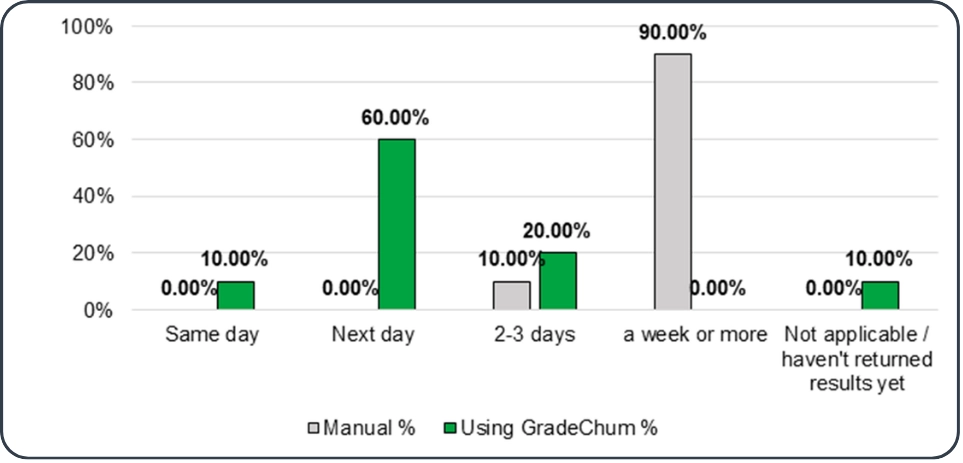
With the reduction in checking time, teachers reported improvements in the overall turnaround time for releasing results and feedback to students.
Prior to using GradeChum, 90% of the teachers took a week or more to return exam results per exam set when checked manually.
With the assistance of GradeChum: 60% reported that the turnaround time was reduced to just one (1) day, 20% reported reduction to just two (2) to three (3) days, and 10% even reported reduction to just less than a day.
This implies that GradeChum reduced average grading turnaround time by approximately 83.59%. From an administrative perspective, faster turnaround times support more efficient academic tracking and helps departments meet internal deadlines such as grade submissions.
Reduction in Score Overrides
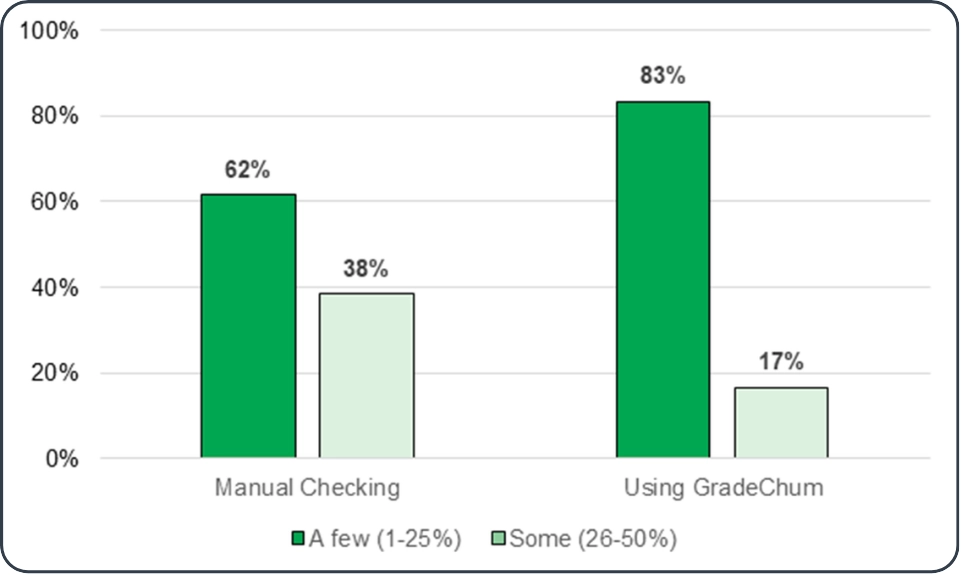
The introduction of GradeChum led to a noticeable decline in the number of post-checking score overrides. Under manual grading, 38% of teachers reported that some scores (26%–50%) were often adjusted after rechecks. In contrast, with GradeChum, this dropped significantly—only 17% reported making similar adjustments. Meanwhile, the share of teachers who made only a few overrides (1%–25%) rose from 62% to 83%.
Teacher Feedback & Satisfaction
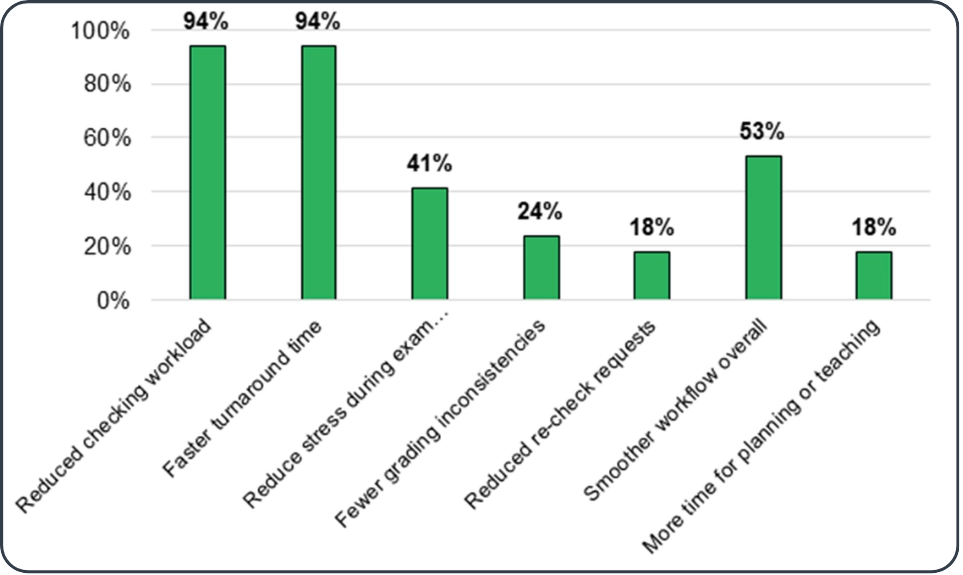
Feedback from teachers who used GradeChum indicates high satisfaction and perceived benefit.
On a scale of 1 to 5, the average rating for how much easier exam checking became was 4.17, reflecting a strong improvement from manual checking processes. 88% of the respondents rated the ease at 4 or 5, citing reduced effort, faster checking, and less cognitive fatigue.
Teachers identified significant benefits from using GradeChum. 94% of teachers reported reduced checking workload and faster turnaround time as the top benefits of using GradeChum. 53% noted a smoother overall workflow, while 41% experienced less stress during exams. Additionally, 24% observed fewer grading inconsistencies and 18% reported fewer re-check requests. These results underscore GradeChum's effectiveness in enhancing grading efficiency, accuracy, and overall teacher well-being.
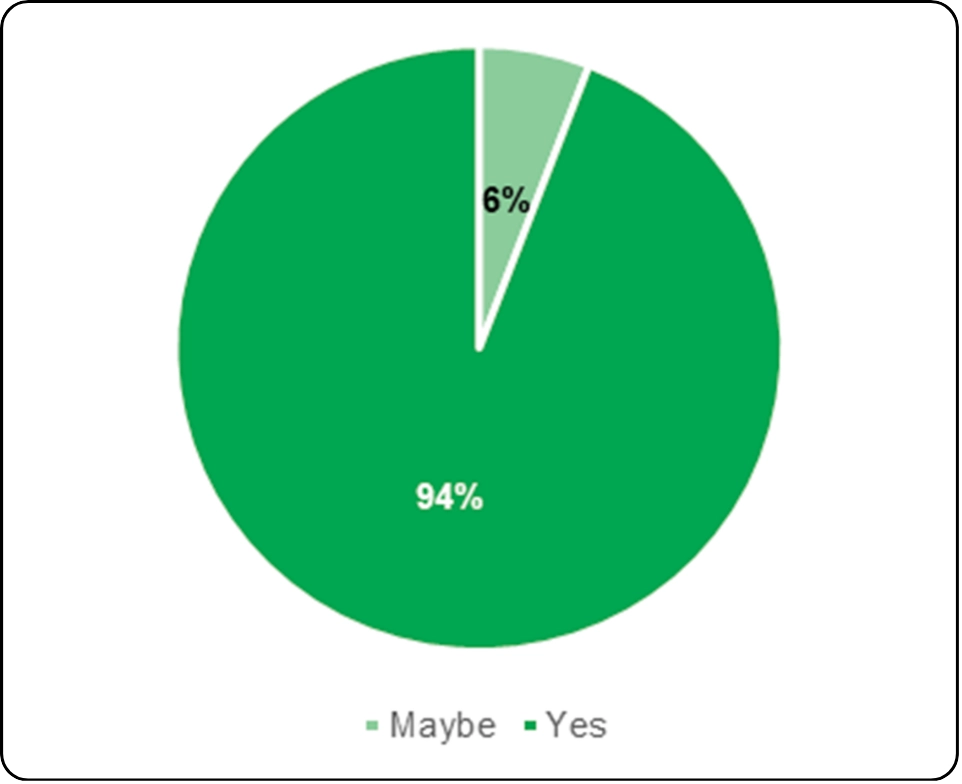
Moreover, 94.12% of teachers expressed intent to continue using GradeChum, while 100% said they would recommend it to other departments or institutions. These results affirm GradeChum's value not only as a grading tool but as a scalable solution trusted by educators.
Student Feedback and Satisfaction
Across over 300 student responses, learners reported a highly positive experience using GradeChum for digital grading and feedback.
Over 80% agreed that their scanned responses were correctly displayed, scores were accurate, and the system graded fairly and objectively. 84% confirmed that their instructor allowed regrade requests.
82.4% found the process clear and 79.9% felt it improved fairness and helped them understand mistakes, adding to the platform's perceived trustworthiness. Furthermore, 87.6% found the system easy to access across devices, 89.5% said results were clear and easy to interpret, and 84.3% rated the interface as organized and user-friendly. Only 13.6% reported any display issues.
Lastly, 91.8% said GradeChum sped up result delivery, 88.5% said it improved grading transparency, 90.9% supported its continued use in future exams, and 83.4% were comfortable with AI-assisted grading.
Testimonials
When asked about their overall experience with GradeChum, teachers and students expressed high satisfaction with GradeChum. Teachers cited faster grading, ease of use, and reduced workload.
“It is easy to navigate, and the support system is very responsive whenever I need assistance.”
“You accomplish work faster.”
On the other hand, students consistently highlighted the speed, fairness, and clarity that GradeChum brought to the grading process. Their comments reflect appreciation for faster feedback, visibility into their answers, and trust in the system's transparency.
“It feels fairer because the results are immediate and I can see my own answers.”
“I was able to see my results faster than usual. It saved time and helped me know what to review.”
Conclusion
The results of this case study clearly demonstrate that GradeChum meaningfully improves grading efficiency, reduces teacher workload, and enhances assessment accuracy. With strong satisfaction ratings, significant time savings, and positive user experiences, GradeChum proves to be a scalable solution that supports both instructional quality and institutional productivity.
At Cebu Institute of Technology – University (CIT-U), the implementation of GradeChum showcased how digital tools can streamline academic processes in a large, multi-department setting. The institution's successful adoption highlights GradeChum's readiness for broader institutional deployment across similar educational environments.