Ink Over Algorithm
The quiet return of the handwritten exam


Jonathan Senchyne, a professor at the University of Wisconsin–Madison, was grading his final exams when he noticed something odd in one student's essay.
Right in the middle of the text was the ChatGPT icon, pasted in by what was probably a copy-paste mistake, with the AI's actual output sitting underneath it. By that point, he had already flagged forty or fifty exams out of his 400-student lecture that read like they had that same AI "voice."
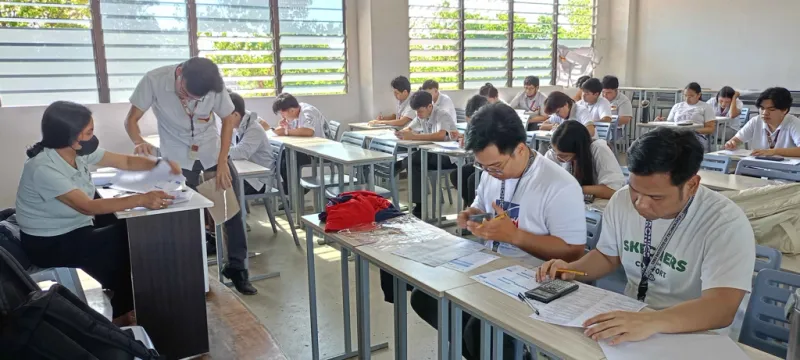
That was the point where he decided to make a change. Blue books came back into his course. These are the same lined paper booklets professors used long before laptops existed. No more take-home essays. From then on, students would write their answers by hand, in class, with nothing available to copy from.
He wasn't the only one making this change. All over the world, schools were quietly going back to something old-fashioned: pen and paper.
The Ban That Didn't Work
When ChatGPT came out in late 2022, schools banned it. A common reaction institutions do when they are scared of something new. Within weeks, many schools said students couldn't use AI at all. In the UK, a third of the country's top universities banned it within the first year. Schools also started using detection software, like Turnitin and GPTZero, to catch AI-written essays before they could be graded.
But the plan didn't work. The detection tools turned out to be unreliable. They sometimes flagged real, human-written essays as AI-made and missed a lot of essays that actually were written by AI. The bans didn't slow anything down either. By 2025, as many as 89 percent of students said they used tools like ChatGPT for schoolwork. Cheating reports at top UK universities hit record highs anyway.
Something had to change. In the end, it wasn't the students who changed. It was the assignments.
Teachers Start Going Back to Basics
The shift didn't happen all at once. It started quietly, around fall 2024, one classroom at a time. One professor at Georgia State University had gone fully digital during the pandemic and never switched back until AI made it impossible to trust take-home work anymore. He returned to paper exam booklets for school year 2024–2025. Other teachers started requiring printed materials in class, fixing small problems as they went.
Then the change became impossible to miss. By spring 2025, college bookstores were ordering more blue books than they had in ten years. Sales went up about 50 percent at the University of Florida, 80 percent at Berkeley, and over 30 percent at Texas A&M. In Madison, the school ran out of blue books before the semester even started.
The idea was simple: if students have to write their answers by hand, in front of a teacher, there's no time to secretly open a chatbot and let it do the work.
High schools started doing the same thing. One California teacher moved almost all student writing back into the classroom, watching students' laptop screens from her desk. Another teacher, in rural Oregon, stopped giving take-home essays completely. "That's almost begging teenagers to cheat," she said. Instead, she has students write in class and explain their ideas out loud.
Maybe Handwriting Just Works Better
It would be easy to think this is only about stopping cheating. But something else showed up around the same time, and it points somewhere more interesting: handwriting itself might teach differently than typing does.
In 2024, researchers at the Norwegian University of Science and Technology fitted university students with EEG caps carrying 256 sensors, then had them handwrite or type the exact same words. Handwriting lit up far more of the brain, with memory, vision, and motor regions syncing together in a pattern typing simply didn't produce. None of this proves a blue-book exam makes anyone smarter. But it does push back a little against the idea that this is only sentiment. There might be something the friction of a pen does that a keyboard can't.
The First Real Results
By 2026, schools started seeing real numbers. One professor in the UK redesigned his course to be fully in-person and handwritten. The number of students earning the highest grade jumped from 13 percent to more than 45 percent in a single year. He was careful not to make too big a deal of it since one class isn't enough to prove anything. But attendance went up too, and he said the whole classroom felt different.
Meanwhile, cheating punishments kept climbing. UK universities recorded more than 2,000 AI-related cheating cases in 2024–2025, which is almost three times as many as the year before. Four top universities even expelled students over it. And yet, 95 percent of UK students admitted to using AI in their studies that same year, up from two-thirds just two years earlier. Going back to handwriting didn't stop students from using AI. It just made sure there was one place AI couldn't reach.
Not Everyone Agrees
Here's where the story gets more complicated.
While Senchyne's students were writing in blue books, some of the world's top universities did the opposite. Oxford and Manchester partnered directly with AI companies, giving students official access to the latest tools. Their reasoning: if students are going to use AI for the rest of their careers, pretending it doesn't exist in school doesn't help them. Banning AI or just working around it with a pen might only be delaying a bigger question about what a diploma is really supposed to prove.
Neither side has won the argument. Schools aren't choosing one future or the other. They're testing both at the same time, on the same students.
The Question Nobody Has Answered
Critics make a fair point: a timed, handwritten exam can't test the kind of research and revision a take-home paper can. It also means more work for teachers: messy handwriting, slower grading, less time for detailed feedback.
And there's a bigger question underneath all of this that nobody has really answered yet: does proving a student didn't cheat also prove they actually learned something? The UK professor's results are impressive. But they're still just one class, one term. Nobody has done a large study on this yet, which means every school reaching for a blue book right now is basically running its own experiment.
Senchyne isn't grading for perfect sentences anymore. He's grading for proof that a real mind, with no help, did the thinking. Whether that's the right thing to measure, or just the only thing schools currently know how to measure, is a question the whole field is still quietly trying to answer.